Is ranking #1 on Google still the ultimate goal? Or is there a more powerful spot—one that gives users answers without a single click?
Welcome to the battle of AEO vs SEO, where answer engine optimization (AEO) is quickly redefining how brands get discovered online. Traditional search engine optimization (SEO) helped businesses climb the rankings. But today, Google is changing. It’s no longer just a search engine—it’s becoming an answer engine.
Instead of listing ten blue links, Google now delivers direct answers through featured snippets, knowledge panels, and zero-click results. That means the top spot in search is no longer just about being clickable—it’s about being the answer. And that’s where AEO comes in. The shift isn’t subtle. It’s reshaping how we create, format, and structure online content. Businesses that fail to adapt will fade. Those who embrace AEO will lead.
At Your IT Expert Limited, we help companies navigate this shift. We combine smart SEO strategies with answer-focused content. Our goal is to help businesses gain visibility in today’s evolving search landscape. This guide explains the key differences between AEO and SEO. You’ll learn how Google’s algorithms are changing—and how to build a strategy that keeps you ahead.
What Is SEO? A Quick Recap
Before we dive into the debate of AEO vs SEO, let’s quickly revisit what SEO means.
Search Engine Optimization (SEO) is the process of improving your website so it ranks higher on Google and other search engines. The goal is to increase your site’s visibility to users searching for relevant topics, products, or services.
SEO relies on a few key tactics:
- Keyword Usage – Understanding what your audience searches for and using those words naturally in your content.
- On-Page SEO – Structuring content with clear headings, meta tags, internal links, and keyword placement.
- Technical SEO – Making sure your site loads fast, works on mobile, and is easy for search engines to crawl.
- Backlinks – Earning links from reputable sites to boost authority.
- Content Quality – Publishing original, useful, and engaging content that solves a user’s problem.
These strategies helped websites climb the rankings for years. Google rewarded sites that matched search terms and showed expertise. But the search has changed. People now want quick, direct answers. They don’t always click. Often, the solution appears right on the results page.
That’s where the shift begins—and why AEO vs SEO matters. While SEO still drives traffic, it’s no longer the only goal. Now, it’s also about getting featured and being seen—even without the click. In the next section, we’ll break down what Answer Engine Optimization means and why it matters more than ever.
What Is AEO? Why It’s Emerging
To truly compare AEO vs SEO, it’s important to understand what Answer Engine Optimization (AEO) is. AEO is all about making your content the direct answer to a user’s question. It focuses on visibility in featured snippets, People Also Ask boxes, and voice search responses—not just page rankings. Unlike SEO, AEO helps your content appear even when the user doesn’t click.
This shift is happening because over half of all searches now result in zero clicks. Users want instant answers, and Google is evolving to meet that demand. Voice assistants like Siri and Google Assistant are speeding things up even more. People speak in full questions, and they expect short, accurate responses. Google uses AI tools like BERT and MUM to understand those natural queries better.
To benefit from AEO, your content must be clear, concise, and well-structured. Use short answers (40–60 words), natural language, and schema markups like FAQ or HowTo. In the debate of AEO vs SEO, AEO gives you visibility—even when users don’t visit your site.
AEO vs. SEO: Core Differences
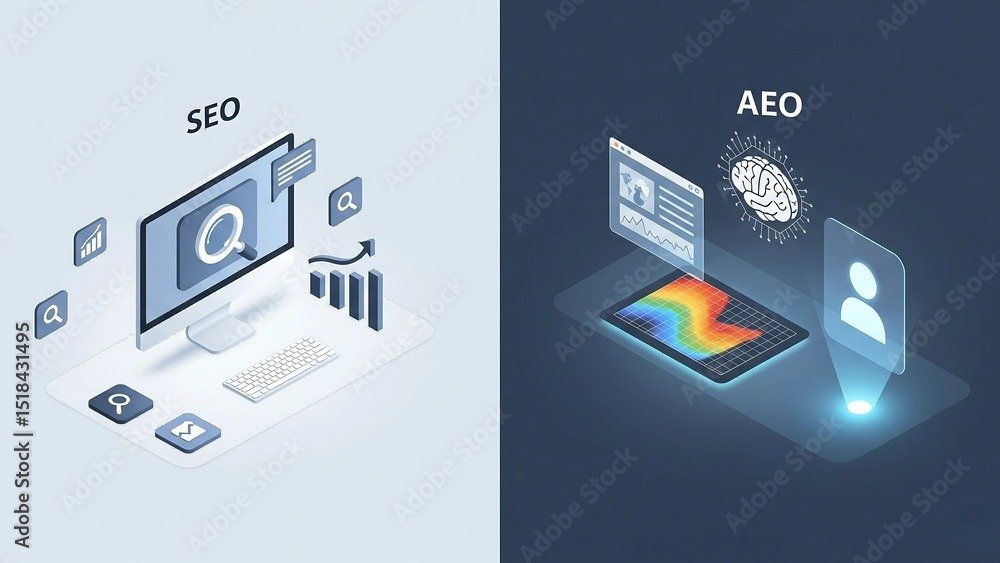
Now that you understand both strategies, let’s compare AEO vs SEO directly. While they both aim to improve visibility, they serve different purposes and work in different ways.
SEO is about bringing people to your website. It uses keywords, backlinks, and optimized content to improve your position in search results. The goal is to earn clicks and drive traffic.
AEO focuses on helping your content appear inside the search results—not just in them. It’s built for zero-click searches, voice results, and instant answers. With AEO, success means showing up at the top, even if users don’t click.
Here’s a side-by-side comparison:
| Feature | SEO | AEO |
| Goal | Rank pages & earn traffic | Be the answer in SERPs |
| Focus | Keywords, backlinks, technical SEO | Questions, structure, and schema |
| Output | Page rankings | Featured snippets, voice answers |
| Tools | Title tags, meta descriptions, links | FAQ schema, natural language, markup |
| Metrics | Clicks, traffic, bounce rate | SERP visibility, snippet ownership |
| Best For | Long-form content & conversions | Quick, direct answers & brand authority |
In AEO vs SEO, both play a role. SEO gets you found. AEO gets you featured.
The Algorithm Shift: BERT, MUM, and Beyond
To understand AEO vs SEO, you need to see how Google’s algorithms have changed. Old SEO strategies focused on keywords and backlinks. Today, Google uses advanced AI to understand meaning, not just matches.
BERT helps Google grasp the context of a sentence. It understands how words relate to each other. This lets it better interpret search intent.
MUM goes even further. It can understand language, images, and concepts across different formats and languages. It’s designed for complex, real-world questions.
These models show that Google is moving beyond keyword matching. It now values relevance, clarity, and intent. This is where answer engine optimization takes the lead. SEO still gets your page ranked, but AEO helps you become the direct answer. To succeed, your content must speak the user’s language—and do it fast.
Zero-Click Searches: Threat or Opportunity?
Zero-click searches now make up over half of all Google queries. These are searches where users get what they need—without clicking any link. At first glance, this looks like a problem for SEO. After all, no click means no traffic.
But in the debate of AEO vs SEO, AEO turns this challenge into an opportunity. If your content appears as a featured snippet, People Also Ask result or knowledge panel, you’re still getting seen—even if users don’t visit your site.
This kind of visibility builds trust. It shows that Google considers your content the best answer. In many cases, users return to the brand they remember when they’re ready to buy, subscribe, or engage. With AEO, the goal isn’t just traffic—it’s authority. Being the answer boosts your presence even when the click doesn’t come.
How Structured Data Powers AEO
One big difference in the AEO vs SEO debate is how Google reads your content. SEO relies on keywords and page structure. AEO goes further. It uses structured data to show Google exactly what your content means.
Structured data (also called schema markup) adds context. It helps search engines understand the content’s intent—not just the words.
Key schema types that support AEO include:
- FAQPage – Labels questions and answers to appear in SERP boxes.
- HowTo – Ideal for guides with clear, ordered steps.
- Article – Gives Google info about your blog or news content.
- QAPage – Tags community Q&As or help content.
- Breadcrumb – Improves how pages are shown in search navigation.
Using schema increases your chances of appearing in featured snippets and zero-click results.
In the world of AEO vs SEO, structured data is your silent advantage. It turns well-written content into something Google can easily trust and feature.
Voice Search & AEO: Perfect Match
Voice search is changing how people use Google. Instead of typing short phrases, users now speak full questions. They expect fast, simple answers in return. This shift plays directly into the strengths of Answer Engine Optimization.
In the battle of AEO vs SEO, AEO is far better suited for voice-based queries. Why? Because it delivers short, clear, and structured responses—exactly what voice assistants prefer.
Why AEO Supports Voice Search:
- Natural Language – AEO content is written in a conversational style, ideal for spoken queries.
- Concise Answers – Voice results pull 40–60 word snippets. AEO is built for that format.
- Structured Data – Schema markup helps voice assistants understand and select your content.
- Question-Based Headings – AEO content is often organized by common questions, just like voice queries.
Voice search continues to grow, and most spoken responses are pulled from featured snippets or structured answers. That makes AEO a perfect fit.
In AEO vs SEO, AEO offers a clear edge in voice-first environments—where being concise and clear is everything.
When SEO Still Matters Most
While AEO is gaining attention, SEO is far from obsolete. In the discussion of AEO vs SEO, SEO still holds a vital place. Some queries need more than quick answers. They demand content with depth, structure, and detailed insight. That’s where SEO continues to lead.
In-Depth Articles and Blogs
When users research or compare complex topics, they need depth. Long-form content helps answer detailed questions. SEO supports this by organizing content with keyword clusters, internal links, and structured headings. AEO doesn’t offer the same depth or control over long-tail strategy.
E-Commerce and Product Pages
Buyers want more than quick facts. They need product images, pricing, specifications, comparisons, reviews, and trust signals. SEO ensures these elements are indexed, optimized, and discoverable in competitive search spaces.
Building Backlinks and Domain Authority
AEO focuses on format; SEO builds trust. Backlinks from reputable websites boost your authority and help improve domain-wide visibility. AEO benefits from this trust, but it doesn’t create it.
Technical Optimization and UX
Site speed, mobile usability, crawlability, and clean architecture are all essential for performance—and they’re pure SEO. Without this foundation, even perfectly structured answers won’t get surfaced.
In short, SEO supports the structure that AEO depends on to succeed.
How to Combine AEO and SEO
In the debate of AEO vs SEO, the smartest approach isn’t choosing one—it’s combining both. SEO builds your foundation, while AEO helps you show up where users look for instant answers. Together, they form a complete visibility strategy.
Layer 1: Keyword Research + User Intent
Start with SEO tools to find high-traffic terms. Then reshape them into natural, question-based queries to match AEO needs.
Layer 2: Content Structure + Answer Blocks
Use long-form content to cover the topic in depth. Add short, 40–60 word answer blocks under H2s to win snippets.
Layer 3: Technical SEO + Schema Markup
Ensure your site is fast, mobile-friendly, and crawlable. Then add structured data like FAQPage, HowTo, or Article.
Layer 4: Authority Building + SERP Visibility
Earn backlinks to improve your domain trust. AEO leverages that authority to claim top positions in voice and zero-click search.
By layering both strategies, you don’t just rank—you become the answer.
AEO vs SEO: What’s Next?
Search is changing faster than most businesses can keep up. Algorithms evolve monthly. User behavior shifts daily. And with the rise of zero-click results, many brands are left wondering what still works—and what doesn’t.
The truth is, this isn’t a battle between AEO vs SEO. It’s a shift in how people search and how Google responds. SEO was built for the web’s early phase—click-driven, keyword-heavy, and traffic-focused. AEO is Google’s answer to a world that wants fast, voice-friendly, direct responses without leaving the search page.
So what’s the solution? Learn to do both. Use SEO to build long-term authority, structure, and visibility. Layer in AEO to win snippets, voice queries, and zero-click exposure. Don’t replace one with the other. Blend them into a modern strategy that adapts as search evolves.
The future doesn’t belong to the loudest voice—it belongs to the most helpful answer.
Conclusion
The debate between AEO vs SEO isn’t about which one wins—it’s about how they work together. Search has changed, and so have the expectations of users. They no longer want to dig through results. They want instant answers. That’s where AEO shines. But SEO still plays a crucial role in building your content foundation.
SEO ensures your content is visible, trusted, and technically sound. It helps you reach the top of search results and drive long-term traffic. AEO complements this by helping your content appear in snippets, voice search, and zero-click features—formats built for today’s impatient searchers. Together, they form a full-spectrum strategy. SEO brings structure and authority. AEO delivers clarity and speed. Ignoring one limits the impact of the other.
At Your IT Expert Limited, we help businesses stay ahead by combining SEO basics with AEO strategies. This improves visibility, builds trust, and keeps them ready for future search changes. If you want to lead in search, don’t choose between AEO and SEO. Learn to master both. The future belongs to brands that don’t just rank—but answer, guide, and serve users better than anyone else.